
File Size vs Pixel Dimensions: Why Images Get Rejected Under the MB Limit
Why portals like Shopify, job applications, and government forms reject photos even when they are under the file size limit, and how to fix both constraints.
Why portals like Shopify, job applications, and government forms reject photos even when they are under the file size limit, and how to fix both constraints.
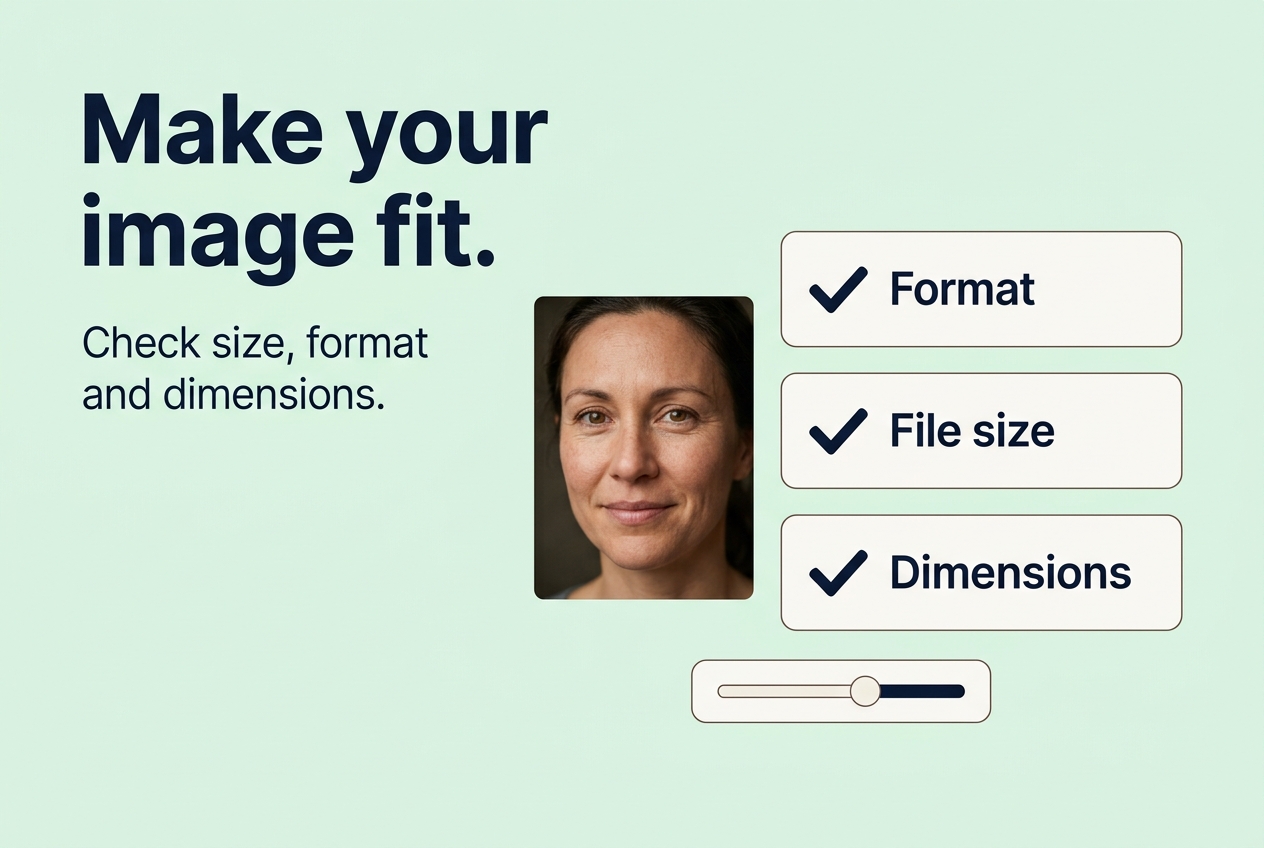
File Size vs Pixel Dimensions: Why Images Get Rejected Under the MB Limit
Direct Answer: File size (measured in Kilobytes or Megabytes) and pixel dimensions (width × height in pixels) are completely independent metrics. A photo can be very small in file size (e.g. 500 KB) while having huge pixel dimensions (e.g. 6000 × 4000 = 24 Megapixels). Platforms like Shopify, Etsy, and portal uploaders reject images that exceed maximum pixel bounds or megapixel caps regardless of how small the byte size is.
The Megapixel Trap Explained
When an online portal processes an uploaded image, its web server must decode the compressed JPEG or WebP into uncompressed memory (RAM):
$$\text{Memory Required} = \text{Width} \times \text{Height} \times 4\text{ bytes per pixel}$$
A 24-megapixel smartphone photo requires nearly 100 Megabytes of uncompressed RAM to decode in memory, even if the compressed JPEG file was only 800 KB on disk. For this reason:
- Shopify enforces a strict 20 Megapixel ceiling ($Width \times Height \le 20,000,000$).
- Government Portals (SSC, UPSC, US Visa) enforce strict width/height boxes (e.g., exactly 140 × 60 px or 600 × 600 px).
How to Check Both Constraints in Browser
Using our Upload Requirements Checker:
- Choose your image.
- Enter both your target maximum file size (e.g. 200 KB) and pixel dimensions (e.g. max 2048 × 2048 px).
- The tool verifies both constraints side by side in browser memory.
- Click Prepare & optimize to downscale the dimensions and compress the bytes simultaneously.
Last updated: July 2026
This guide is reviewed by the BIC Editorial Team to keep the recommendations accurate, private, and practical for browser-based image workflows.
About the Author
Abhay Tabbay is a web developer and image optimization specialist focused on privacy-first browser tools that help people convert, resize, and optimize images without uploading files to the cloud.
Related Articles
Try the Tool
Need this workflow right now? Open our free in-browser image tools and process files locally.
Open Browser Image Converter Tools